Cavitation
Predict cavitation damage, pressure fields, and transient bubble dynamics with ML-accelerated CFD
Technical Capabilities in MPflow
In nozzle and internal flow applications, cavitation plays a critical role in spray dynamics and atomisation efficiency.
MPflow provides dedicated CFD solvers, fully compatible with OpenFOAM libraries, capable of modelling flow acceleration through sharp contractions, pressure drops, and cavitation phenomena with high robustness.
Our models have been validated across key parameters:
• Geometry (including pipe flows and propellers)
• Operating conditions (encoded efficiently within neural networks)
• Pressure distribution (including flashing phenomena)
• Fluid composition (including different fuel mixtures)


Our CFD approach
Using MPflow, MultiFluidX delivers high-fidelity simulation of cavitating flows in complex geometries, combining advanced CFD with physics-aware machine learning:
-
Identification of cavitation-prone regions
-
High-accuracy prediction of pressure and velocity fields using proprietary solvers
-
ML-accelerated RANS and LES turbulence modelling
-
Modelling of bubble nucleation under rapid depressurisation
-
Unified simulation of internal flow and cavitation-driven spray formation
-
Design optimisation and failure risk reduction
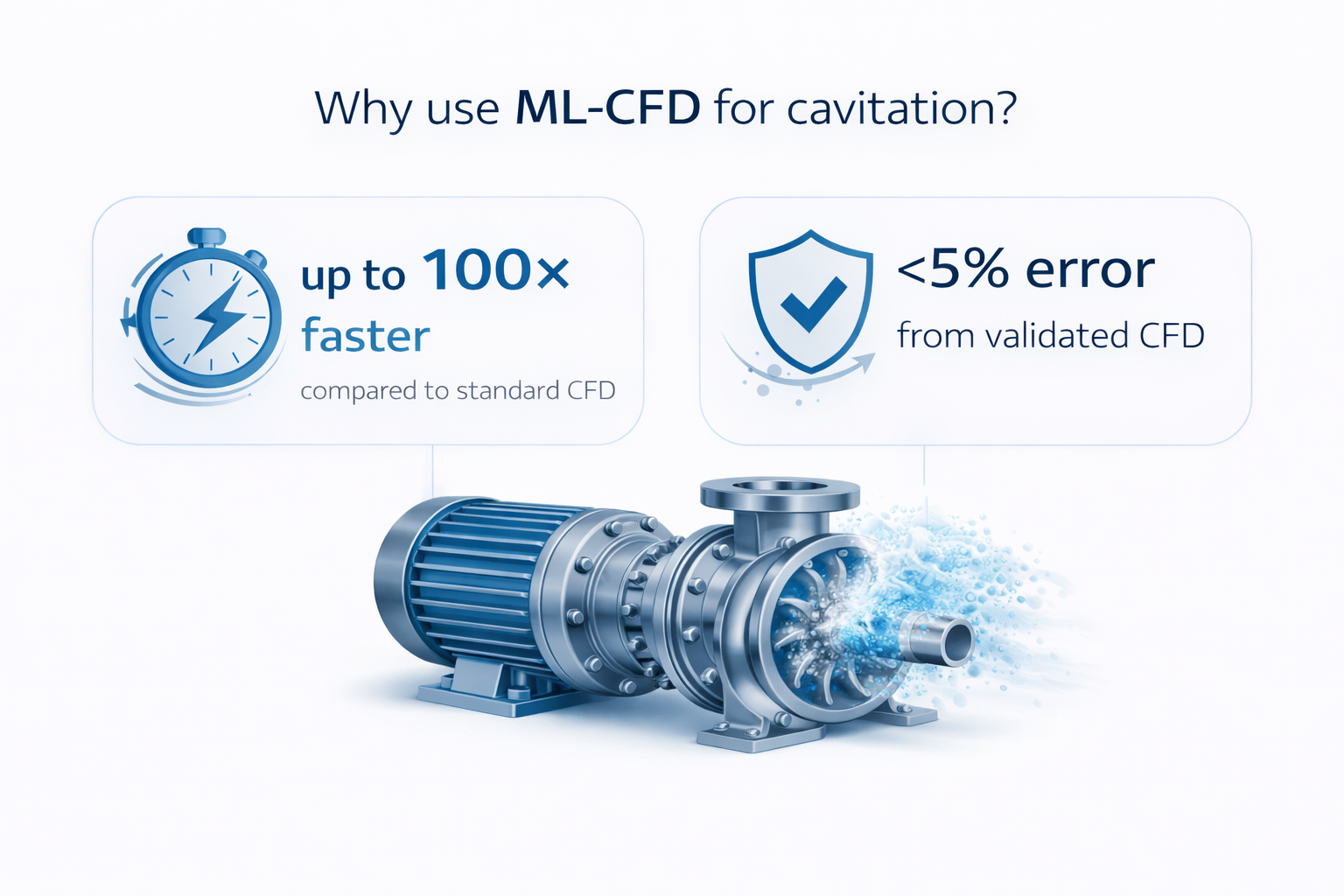
Why use ML-CFD for cavitation
- Up to 100× speed-up compared to traditional CFD, enabling near real-time cavitation assessment
- High accuracy (<5% deviation) from validated CFD for pressure fields and cavitation structures
- Instant evaluation of transient effects, including rapid depressurisation and bubble dynamics
- Scalable parametric analysis, enabling exploration across geometries, fluids, and operating regimes