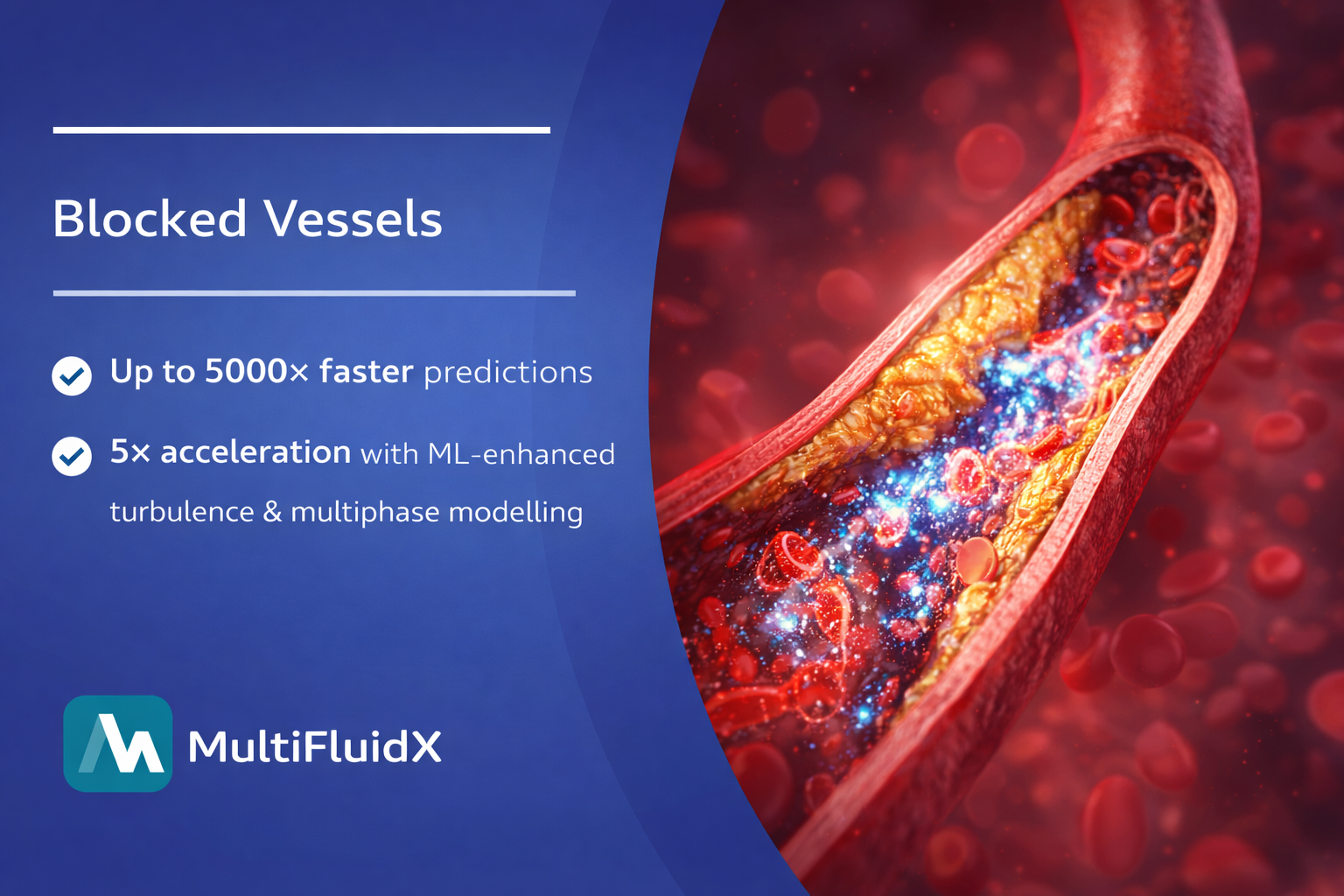
Blocked vessels
High-fidelity modelling of blood flow in stenosed arteries to predict turbulence, cavitation, and plaque instability mechanisms associated with cardiovascular events such as myocardial infarction
Technical capabilities in MPflow
- Multiphase CFD modelling of blood flow in stenosed arteries
- Resolution of pressure drops and recovery across constrictions
- Cavitation modelling including bubble inception and collapse in vascular flows
- Prediction of shear stress distributions linked to plaque formation and rupture
- Support for patient-specific geometries and varying stenosis severity (50–75%+)
- Transient simulations capturing pulsatile blood flow conditions


Our CFD approach
- High-resolution simulation of flow through coronary artery stenosis
- Identification of low-pressure regions triggering cavitation
- Coupled analysis of turbulence, shear layers, and recirculation zones
- Investigation of plaque stability under varying flow conditions
- Modelling of pressure fluctuations driving bubble dynamics and collapse
- Detailed insight into flow-induced mechanisms leading to thrombotic events
Physics-based ML acceleration
- ML-enhanced prediction of pressure fields and cavitation-prone regions
- Acceleration of patient-specific vascular flow simulations
- Rapid estimation of hemodynamic indicators (WSS, oscillatory shear index)
- Hybrid CFD–ML framework ensuring physical consistency in biomedical flows
- Real-time evaluation for clinical decision support and treatment planning
Why ML-CFD matters for Blocked Vessels
- Up to 5000× faster predictions: rapid evaluation of stenosis severity and cardiovascular risk
- 5× acceleration with ML-enhanced turbulence and multiphase modelling
- High accuracy (<3% deviation) in pressure drop, wall shear stress, and cavitation onset
- Instant assessment of patient-specific conditions and disease progression
- Supports early diagnosis of plaque instability and rupture risk
- Enables digital twins for personalised cardiovascular care